

- All
- Favorite
- Popular
- Most rated
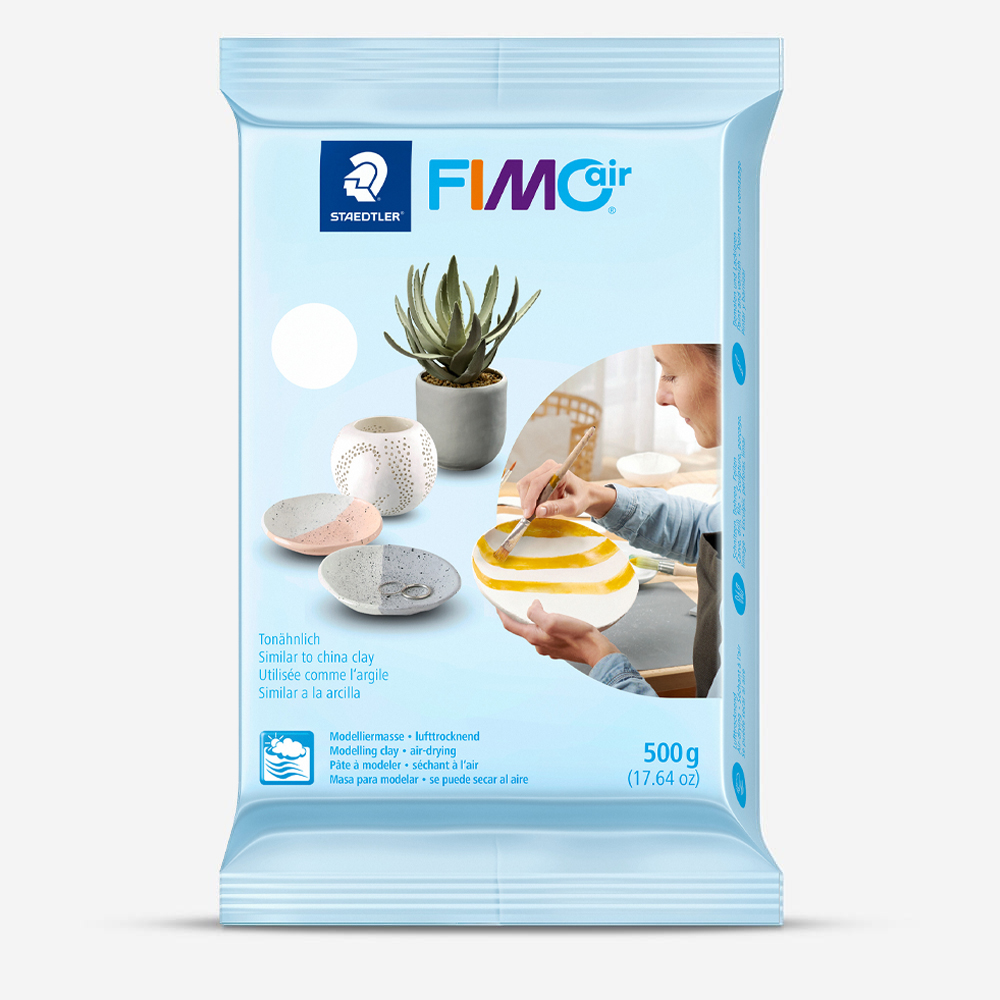
Staedtler Fimo Air Airdrying Clay 500g – White, Water-Based
Offers: 5
Staedtler Fimo Air Drying Modelling Clay 1kg – White
Offers: 5Fimo has been the polymer clay that serious crafters reach for since before most of today's hobbyists were born. The brand originated in Germany — the name a contraction of the original product name Fimolit — and has spent the better part of six decades establishing itself as the benchmark against which every other polymer clay is measured. I've spent sixteen years in the art supplies industry, nearly a decade of that running digital marketing for one of the UK's largest online art retailers, and in that time I've watched Fimo go from being a niche product understood mainly by serious sculptors to something that sits comfortably in the baskets of parent crafters, jewellery makers, art students and professional miniaturists alike. The audience has broadened enormously. The quality hasn't changed.
The history is worth knowing because it explains the product. Fimo was developed in Germany in the 1950s and was initially adopted by the doll-making industry before artists and crafters discovered what you could actually do with an oven-hardening modelling clay at home. Staedtler acquired the brand and expanded the range significantly over subsequent decades, recognising that the core technology — a PVC-based polymer that hardens permanently in a domestic oven at low temperatures — had applications far beyond its original purpose. That expansion is what gives you the product family you see today, and it's a genuinely impressive one.
The range breaks down into several distinct lines, and understanding which one suits your project is honestly the most important purchasing decision you'll make before you spend anything. Fimo Soft is the entry point — and I mean that entirely without condescension. It's soft straight out of the packet, conditions quickly, and handles well for beginners who are still developing their technique. It's also the line I'd reccommend to parents buying for children who are serious about craft rather than just playing, because the ease of handling means frustration is low and results come quickly. Fimo Soft is available in a wide palette of colours and is the most affordable line in the range. It sells in higher volume than any other Fimo product for good reason.
Fimo Professional sits at the other end of the spectrum. It's firmer, which sounds like a disadvantage until you realise that firmness is precisely what gives you control. When you're blending colours, working fine details, or creating miniature pieces that need to hold their shape precisely under your hands, a clay that maintains its form rather than deforming slightly with every touch makes an enormous difference to the finished result. Fimo Professional also produces a finer, smoother surface finish after baking, which matters significantly if you're painting or varnishing the piece afterwards. It's the line that sculptors, miniaturists and serious jewellery makers tend to migrate towards once their skills have moved past the beginner stage — and once you've worked with it, it's difficult to go back.
Fimo Effect is the range that tends to generate the most excitement among the 36,000 artists who follow Discount Art Supplies across our platforms — and deservedly so. This is where you find the metallics, the glitter effects, the stone-effect clays that genuinely resemble granite or quartz after baking, the translucent formulations, the neons and the glow-in-the-dark lines. For jewellery making in particular, the metallic and glitter Effect clays have transformed what's achievable at home. The translucent formulations open up caning techniques — where complex patterns are built through the cross-section of a log of clay and then sliced — that simply wouldn't be possible with an opaque clay. Effect clays are occassionally sold in slightly smaller blocks than the Soft and Professional lines, which is worth factoring in when comparing prices per gram rather than per block.
Fimo Leather Effect deserves a special mention because it genuinely does something different to anything else in the range. Once baked, it has a flexible, leather-like quality rather than the rigid hardness of conventional polymer clay — making it particularly well-suited to accessories like bracelets, bag charms and bookmarks where flexibility under daily use matters. It's been one of the more popular additions to the range in recent years and has built a loyal following within the craft jewellery community specifically.
For younger crafters, Fimo Kids is the entry point — a softer, more pliable formulation in bright primary colours that handles well for smaller hands and produces safe, durable results. And for work that doesn't involve an oven at all, Fimo Air and Fimo Air Light cover the air-drying side of the range. Fimo Air Light is particularly useful for larger sculptural pieces where weight is a genuine consideration, drying to a noticeably lighter finish than standard air-drying clays.
Getting the best Fimo deals is something I get asked about regularly. The honest answer is that Fimo pricing is relatively stable compared to some of the premium watercolour and oil brands I've tracked over the years, but the differences between retailers are real and worth checking before you commit. Amazon is often competative on multipacks and larger sets — particularly the Fimo Soft and Professional mixed colour blocks — but independent art retailers occasionally price individual blocks more keenly, especially during seasonal sale events. Cass Art, Jacksons and Crafty Arts all carry the range and all run promotions at different points in the year. Our price comparison tool on this page pulls live pricing from across all of them, so you can see at a glance where the best deal sits today rather than spending twenty minutes checking tabs.
One thing worth knowing before you buy: Fimo mixed sets represent significantly better value per block than buying individual colours, assuming the colour selection works for you. If you're building a palette from scratch, a large mixed set is definitley the place to start — then once you've identified the colours you reach for most often, you can start buying those individually in full-size blocks.
Frequently Asked Questions
Is Fimo safe to use at home? Yes. All Fimo polymer clays are CE certified and formulated to meet European safety standards. They should be baked according to the package instructions — typically around 110°C — in a ventilated space, and dedicated baking equipment is advisable if you're working with clay regularly rather than occasionally.
What temperature does Fimo bake at? Most Fimo lines bake at 110°C (230°F) for 30 minutes per centimetre of thickness. Fimo Professional bakes at 130°C. Always check the specific line's packaging as recommendations vary slightly.
Can you mix Fimo colours? Absolutely — and colour blending is genuinely one of the great pleasures of polymer clay work. Fimo Soft conditions quickly enough that blending is straightforward for beginners. Fimo Professional requires slightly more working but gives a more predictable result when you're trying to match a specific shade consistently.
Does Fimo dry out if you leave it? Unopened Fimo stores well for several years in cool, dry conditions away from direct sunlight. Partially used blocks should be wrapped tightly in cling film. Clay that has stiffened slightly with age can usually be reconditioned by working it thoroughly with your hands, or by adding a small amount of dedicated clay softener.
Where is the cheapest place to buy Fimo in the UK right now? It genuinely varies by retailer and by time of year. Use our price comparison below — it pulls live pricing across all major UK art supplies retailers and updates in real time. Ten seconds of checking before you buy can save you a meaningful amount across a full clay order.