Written by Paul Worrall
Walk into any art shop and the pencil aisle can look like a wall of identical yellow and grey sticks. The labels are full of letters and numbers, the sets range from a few pounds to well over fifty, and nobody tells you which ones you actually need. I’ve watched artists buy the wrong pencils for years, usually by spending too much on a big set they never fully use. The truth is simple: a handful of good pencils will do almost everything.
I’m Paul Worrall. I spent nearly a decade running digital marketing for ARTdiscount, one of the UK’s larger online art retailers, and I now run Discount Art Supplies — a price comparison platform used by over 28,000 UK artists every week. Pencils are one of the categories where I see the biggest price differences between retailers, so here’s my honest guide to what’s worth buying, what’s not, and how to avoid overpaying.
Quick Picks
- Best all-round graphite set: Staedtler Mars Lumograph Pencils
- Best ready-made sketching set: Derwent Sketching Pencils
- Best classic budget choice: Faber-Castell 9000 Pencils
- Best for sketch and wash: Water-Soluble Graphite Pencils
- Best for bold, dark marks: Charcoal Pencils
- Best for fine, consistent lines: Lead Holder or Mechanical Pencil
- Best essential extra: Kneaded Eraser
What the letters and numbers on sketching pencils mean
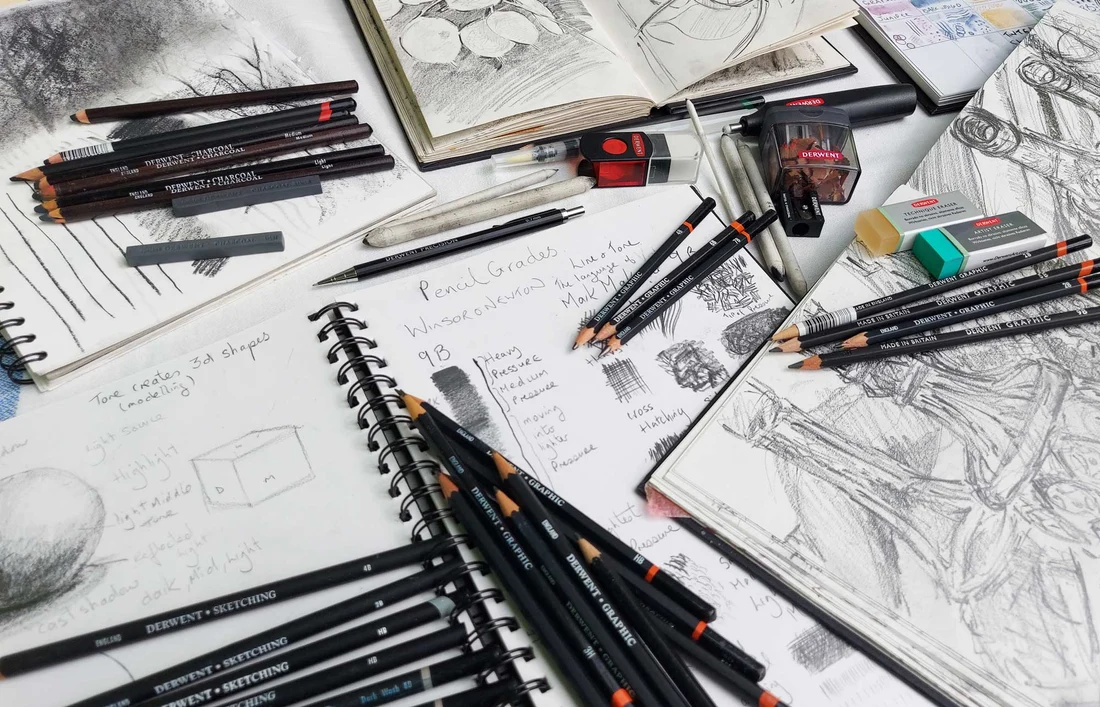
Every graphite pencil is graded by how hard or soft the lead is. H stands for hard, B stands for black (soft), and HB sits in the middle. Hard pencils make pale, crisp lines and hold a point for a long time, which suits light construction lines and technical drawing. Soft pencils make darker, smoother marks that smudge easily, which is exactly what you want for shading and expressive work. The bigger the number in front of the letter, the harder or softer the pencil is, so a 6B is much softer and darker than a 2B.
For sketching you rarely need the hard end of the scale. A practical working set is an HB for outlines, a 2B for general drawing, a 4B for tone and a 6B for deep shadows. Add an H or 2H only if you want very light guide lines that disappear under later work.
Best graphite sketching pencils
Staedtler Mars Lumograph is the set I’d point most people towards. It’s a long-established artist’s pencil, available in tins of different sizes, with smooth, consistent lead and a wide choice of grades. It’s the kind of pencil that behaves the same way every time, which matters more than people realise when you’re learning how to control tone.
🛒 Shop Staedtler Mars Lumograph on Amazon 🔍 Compare Lumograph prices
Derwent’s sketching pencils are the easiest option if you’d rather buy a ready-made tin with a sensible spread of grades chosen for you. Derwent is one of the best-known UK pencil makers, and their sets are a popular gift for beginners because everything you need is in one box.
🛒 Shop Derwent sketching pencils on Amazon 🔍 Compare Derwent prices
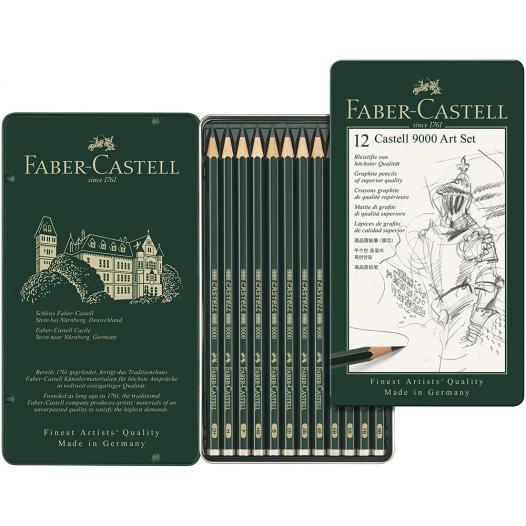
Faber-Castell 9000 is another staple that’s been used by artists and designers for a very long time. It’s a dependable, good-value choice, and often cheaper than the more premium sets. If you’re not sure how serious you are about drawing, this is a sensible place to start.
🛒 Shop Faber-Castell 9000 on Amazon 🔍 Compare Faber-Castell prices
The genuine trade-off between them is mostly price against feel. The premium sets tend to have smoother lead and more consistent grading, but a decent mid-priced set will serve a beginner perfectly well, and I’d always rather see someone buy a good small set than a huge cheap one. Prices vary a lot between retailers, so check before you buy.
Water-soluble sketching pencils
Water-soluble pencils look and feel like ordinary pencils, but the lead dissolves when you touch it with a damp brush. That lets you draw a line, then soften or spread it into a wash, so you get linework and tone in a single sketch. They’re brilliant for travel sketching and landscapes, and they’re one of the easiest ways to dip into mixed media without buying paints. Use paper with a bit of weight, because thin sketchbook paper will buckle once it gets wet.
🛒 Shop water-soluble graphite on Amazon 🔍 Compare water-soluble prices
Charcoal pencils for sketching
Charcoal pencils give you the rich, velvety black that graphite can’t quite reach. They’re cleaner than a stick of willow charcoal because the charcoal is wrapped in wood, and they sharpen to a point for detail. The catch is that charcoal smudges very easily and doesn’t erase as cleanly as graphite, so you’ll want a fixative to protect finished work. They’re a good choice if your sketching leans towards bold, dramatic tone.
🛒 Shop charcoal pencils on Amazon 🔍 Compare charcoal pencil prices
Mechanical pencils and lead holders
A mechanical pencil gives you a constant, fine line without ever sharpening, which makes it a good tool for detailed sketches, urban sketching and technical work. It won’t give you the broad, soft shading of a 6B wooden pencil, though. If you want something in between, a lead holder takes a thicker lead that you can sharpen to whatever point you like, and it’s a favourite with architects and illustrators. I’d call a mechanical pencil a useful extra, not a replacement for a proper set.
🛒 Shop lead holders on Amazon 🔍 Compare lead holder prices
What a beginner actually needs
Honestly, not much. One small set covering HB to 6B, a sharpener, and a kneaded eraser is all you need to start. The kneaded eraser is the one extra I’d always recommend, because it lifts graphite without leaving crumbs or damaging the paper, and you can shape it into a point for highlights. Spend the money you save on a decent sketchbook, because good paper makes a bigger difference to your drawings than an expensive pencil does. The most common mistake I see is buying a huge set first and then never needing the middle grades, which is a waste, and it’s neccessary to watch the budget when you’re starting out.
🛒 Shop kneaded erasers on Amazon 🔍 Compare eraser prices
Getting the best price on sketching pencils
Pencil prices vary more than most people expect, and the same tin can cost noticably different amounts at different shops. Always check the price comparison before buying, because the cheapest retailer changes from week to week. Sets are usually better value than buying single pencils, as long as you’ll use most of the grades, and retailers tend to discount them during back-to-school and seasonal sales. I post the offers as they land, so the newsletter is the easiest way to catch one. If you recomend a set to a friend, tell them to compare first too.
🔍 Compare all sketching pencil prices
FAQ
What are the best pencils for sketching?
A small set of graphite pencils covering a range of grades is the best place to start. Something like an HB, a 2B, a 4B and a 6B will handle most sketching, from light outlines to deep shading. Established sets from Staedtler, Faber-Castell and Derwent are reliable choices.
What does HB, 2B and 4B mean on a pencil?
The letters describe how hard or soft the lead is. H means hard and makes lighter, sharper lines, while B means soft and black and makes darker, smoother marks. HB sits in the middle. The higher the number in front of the B, the softer and darker the pencil.
What pencils should a beginner use for sketching?
A beginner needs very little: an HB for outlines, a 2B for general sketching and a 4B or 6B for shadows, plus a sharpener and a kneaded eraser. A good small set is better than a large cheap one.
Are mechanical pencils good for sketching?
They can be. A mechanical pencil gives a consistent fine line without sharpening, which suits detailed work and technical sketches. For soft shading and expressive marks, most artists still prefer traditional wooden pencils or a lead holder with a thicker lead.
What are water-soluble sketching pencils?
Water-soluble pencils can be used dry like a normal pencil, then blended with a damp brush to create a wash. They let you combine line and tone in one sketch and are popular for travel sketching and landscapes.
Get the basics right and a few well-chosen pencils will take you a very long way. If you’d like the best deals on art supplies straight to your inbox once a week, join the mailing list, or come and join the conversation in our Facebook group of UK artists. And as always, check Discount Art Supplies before you buy — we compare prices across major UK retailers, so you’re getting the best deal going.