Written by Paul Worrall
Most artists put off business cards until the day they need one. It’s usually a stall at a local fair, a conversation with a gallery owner, or someone at an open studio saying “do you have a card?” and the honest answer being “no, but I’m on Instagram”. That works, but it’s a lot easier to hand someone a card than to spell out a username over the noise of a busy room.
I’m Paul Worrall. I spent nearly a decade running digital marketing for ARTdiscount, one of the UK’s larger online art retailers, and I now run Discount Art Supplies — a price comparison platform used by over 28,000 UK artists every week. I’ve watched a lot of artists build their audience over the years, and the ones who do it well treat a business card as a small, cheap piece of marketing rather than a chore. I haven’t ordered from every printer going, so this is how I’d think about it rather than a ranking of firms.
Quick Picks
- Best for hand-made cards: Blank Business Cards
- Best for stamping your own design: Stamp Carving Kit
- Best for adding colour to a stamp: Ink Pad for Stamping
- Best for keeping them tidy at a stall: Business Card Holder
Do artists still need business cards?
It depends how you sell. If you work entirely online, you can get by without one. But if you ever take part in open studios, sell at fairs and markets, deal with galleries or stockists, or send parcels to customers, a card earns its place. It’s the cheapest way of making sure someone who liked your work can find you again, and it fits in a pocket, a sketchbook or a parcel without taking up any room.
The point I’d make is that a card isn’t there to explain you. It’s there to send people to your portfolio, shop or Instagram. If you’re thinking about where that portfolio lives, I’ve covered the options in Squarespace for artists and Etsy vs Shopify for UK artists.
What to put on an artist business card
Less than you think. Your name, a few words on what you do (“oil painter”, “botanical illustrator”, “ceramic artist”), and one way of finding you, whether that’s a website or an Instagram handle. Add an email address if you take commissions. That’s genuinely all you need.
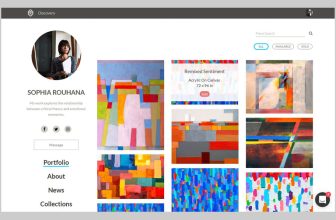
The extra that does the most work is a single image of your art. A card with a strong piece of your work on one side and your details on the other tells someone more in two seconds than a paragraph ever could. If you do add a QR code, make sure it goes somewhere useful, like your portfolio or shop, and test it before you print two hundred. It’s an embarassing thing to get wrong once the cards are in a box.
A quick word on contact details. A professional email address, ideally one that matches your website, looks far better than a random string of numbers at a free provider. A phone number is optional, but if you include one, make sure it goes to voicemail you actually check. And I’d be careful about printing your home address. If you work from a home studio, a town or region is plenty for most people, and you can give the full address to anyone who needs it. With two kids at home, it’s not something I’d put on a card that gets left on tables and handed out to strangers.
What I’d leave off: long lists of services, every social media account you’ve ever opened, and your life story. If the card is crowded, nobody reads it.
Design ideas that suit artists
Because you’re an artist, the card is a chance to show your style. Put your best piece full bleed on the front and keep the back plain and white, which also leaves room for you to write a note or a price on it. Or go the other way and keep a clean, minimal card with plenty of white space, which suits quieter, more precise work.
One thing I’d avoid is changing your design every time you reorder. People remember a consistent look, and a card that matches your website, packaging and social media feels more professional than one that doesn’t.
Choosing a font for your card
Keep it to two fonts at most, and pick one that stays readable when it’s small, because a business card shrinks everything. A clean sans-serif such as Helvetica or Montserrat is the safe choice for contact details and suits modern, graphic work. A serif such as Garamond or Georgia feels warmer and more traditional, which can suit painters, printmakers and anyone whose work has a classic feel.
A common approach is to use one characterful font for your name and a plain, simple one for everything else. Avoid anything too decorative for the small print, and don’t let the lettering fight with your artwork. If the image on the card is busy, the type should be calm, and if the image is quiet, you can afford a bit more personality in the name. Whatever you choose, use the same fonts on your website and social media so your card looks like part of the same brand.
Card stock and finish
Paper stock makes a bigger difference than most people expect. Thicker stock feels like a proper object rather than a flimsy slip of paper, and in my experience people hold on to a card that feels good in the hand. Most printers offer a choice of weights, so if you can, order a sample pack before committing to a few hundred.
For finish, an uncoated, slightly textured card feels more like part of an art practice than a glossy one, and it takes a pen or a stamp much better if you want to add a note by hand. A matt finish is a safe middle ground and tends to look more considered than gloss, especially if your work is colourful. Gloss can make photos of paintings look punchy, but it shows fingerprints and you can’t write on it. If you want to stamp or write on the back, avoid anything coated.
The standard size
The standard UK business card is 85mm by 55mm. It’s worth sticking to, because it fits card holders, wallets and the little pockets at fairs and galleries. A square card or an oversized one looks distinctive, but it won’t fit where people keep cards, and I’d think carefully before choosing one unless the shape is part of what you do.
Making your own by hand
There’s a good case for making at least some cards yourself. Blank cards can be painted, drawn on, stamped or collaged, so every one is a small original. It’s also a lovely thing to hand to a gallery owner or a customer who’s just bought a piece. It doesn’t scale to hundreds, but for a limited batch or a special occasion it’s hard to beat.
A carved stamp is the sweet spot between the two. Carve your logo or a simple motif once, then stamp it onto blank cards in whatever colour you like. It’s cheap, it looks hand-made because it is, and the results have a lot more character than a standard printed card.

🛒 Shop blank business cards on Amazon
🛒 Shop stamp carving kits on Amazon
Where to get them printed
When you need a few hundred that all match, a print firm is the sensible route. Moo and Vistaprint are two of the best known in the UK, and both let you upload your own design. If you design your own cards, Canva is the easiest place to lay them out, and I’ve written about whether the paid version is worth it for artists.
Whoever you use, check the proof carefully before you confirm the order, especially colours. Screens and paper never match exactly, so if your work is colour-sensitive, order a small first batch and look at it in daylight before committing to a big run. Prices change a lot between firms and between paper stocks, so compare a couple before you order rather than going with the first one you find.
Where to actually use them
Having a stack in a drawer doesn’t do much. Keep a few in your sketchbook bag or wallet, put one in every parcel you send, and leave a small pile in any shop, café or gallery that displays your work. At fairs and open studios, a neat business card holder on the table makes it much more likely that people take one. If you sell through a print-on-demand shop, a card tucked into packaging is a good habit too, and I’ve compared the main options in Printful vs Printify for UK artists.
🛒 Shop business card holders on Amazon
FAQ
What size is a standard UK business card?
The standard UK business card is 85 mm by 55 mm. It fits most card holders and wallets, so sticking to it means your card won’t get left out of the places people keep them.
What should an artist put on a business card?
Your name, what you do in a few words, your website or Instagram handle, and one image of your work. Keep it simple, because the card is there to send people to your portfolio, not to replace it.
Do artists still need business cards?
If you sell at fairs, take part in open studios, deal with galleries or ship orders to customers, a card is still the quickest way to put your name in someone’s hand. If you only sell online, you can get by without one, but a small stack costs very little.
Can I make my own artist business cards?
Yes. Blank cards can be painted, stamped, printed with a carved stamp or drawn on by hand, which is a good fit for artists because every card becomes a small piece of your work. Plain printed cards from a print firm are a better choice when you need hundreds that all match.
A business card is a small thing, but it’s one of the few bits of marketing that costs next to nothing and works every time someone takes one. If you’re stocking up on materials for your next batch of work, check Discount Art Supplies first — we compare prices across the major UK retailers, so you’ll definately find the best deal going. And if you want deals straight to your inbox once a week, you can join the mailing list or come and say hello in the Facebook group.