Squarespace for Artists UK — Honest Review 2026
Last updated: April 2026

Let me be straight with you from the off. Squarespace is one of those platforms that gets recommended constantly by people who’ve never actually tried to run a proper e-commerce operation on it. It looks gorgeous in screenshots. The marketing is impeccable. And yes, the templates are genuinely beautiful.
But beautiful and functional aren’t always the same thing — especially when you’re a UK artist trying to sell work online, deal with VAT, integrate print on demand, and not spend your entire Sunday fighting with a website builder when you could be painting.
I’ve spent 16 years in digital marketing, including a decade growing an art supplies brand online. Here’s what I actually think about Squarespace for UK artists in 2026.
What Is Squarespace?
Squarespace is a hosted website builder and e-commerce platform. You pay monthly, you get a website, you can sell things. Unlike WordPress it’s entirely self-contained — hosting, design, and e-commerce all in one box. Unlike Shopify it started as a website builder that added commerce as an afterthought rather than a commerce platform that added websites as an afterthought.
That distinction matters more than most people realise, and we’ll come back to it.
Who Is Squarespace Actually Good For?
Before diving into the details, it’s worth being honest about who Squarespace genuinely suits:
- Artists who want a beautiful portfolio with light selling functionality bolted on
- Artists selling a small number of high-value original pieces rather than volume
- Artists who care deeply about how their site looks and are willing to pay for it
- Artists who aren’t particularly technical and want something that just works without a fuss
If you’re planning to run a serious print on demand operation, sell 100+ SKUs, or build a proper email marketing funnel, Squarespace will frustrate you. I’ll explain why shortly.
Squarespace Pricing for UK Artists in 2026
| Plan | Monthly Cost (annual billing) | E-commerce | Transaction Fee |
|---|---|---|---|
| Personal | ~£11/month | No | N/A |
| Business | ~£17/month | Basic only | 3% per sale |
| Commerce Basic | ~£23/month | Yes | 0% |
| Commerce Advanced | ~£35/month | Full | 0% |
Important: Do not use the Business plan if you’re selling anything. That 3% transaction fee on top of payment processing fees will eat your margins alive on lower priced work. Commerce Basic at ~£23/month is the minimum sensible starting point for any artist who wants to actually sell.
Squarespace also runs regular discount promotions — typically 20-30% off if you catch them at the right time. Worth waiting for if you’re not in a rush to get started.
To put this in context, if you’re spending £23/month on your website you want to make sure you’re getting the best possible prices on your actual art supplies too. Our daily art supply deals page is updated constantly if you want to offset some of those running costs.
The Templates — Let’s Give Credit Where It’s Due

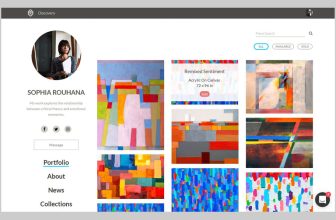
Squarespace templates are genuinely the best in the business for visual work. Full stop. If you’re an artist and presentation matters — and it absolutely should — Squarespace templates will make your work look better than almost any other platform out of the box.
The gallery layouts in particular are excellent. Full bleed images, clean whitespace, minimal distraction from the work itself. When I show artists Squarespace portfolio templates versus the equivelent on Wix or WordPress, the reaction is consistent — they prefer Squarespace every single time.
This isn’t a small thing. Your website is your gallery. First impressions matter enormously when someone is deciding whether to spend £200 on an original piece. Squarespace wins this category comfortably.
The E-commerce — Here’s Where It Gets Complicated
This is where my years of digital experience make me slightly less generous than most Squarespace reviews you’ll read online.
Squarespace e-commerce works perfectly well for selling a handful of original pieces. Add a product, set a price, take a payment. Simple, elegant, done. If that’s all you need, honestly it’s brilliant.
But try to do anything more sophisticated and you’ll start hitting walls fairly quickly:
- Print on demand integration is limited. Printful connects but the integration isn’t as seamless as Shopify. Printify doesn’t integrate natively at all — you’d need a workaround. For a UK artist wanting to sell prints without holding stock this is a genuine limitation worth knowing about upfront.
- Abandoned cart recovery is Commerce Advanced only. Meaning you need the £35/month plan to chase people who nearly bought. On Shopify this is standard on the basic plan.
- The app ecosystem is tiny. Squarespace has a small selection of extensions compared to Shopify’s thousands of apps. If you need specific functionality there’s a reasonable chance it simply doesn’t exist.
- Inventory management is basic. Fine for limited editions but clunky if you’re managing lots of product variants.
None of this is a disaster. But it does mean Squarespace is a portfolio platform with shopping functionality rather than a proper e-commerce platform with a portfolio attached. That’s a subtle but important distinction that will determine whether it’s right for you.
Squarespace vs Shopify for UK Artists
We’ve done a seperate in-depth piece on Shopify for UK artists if you want the full breakdown, but here’s the quick comparison:
| Squarespace | Shopify | |
|---|---|---|
| Design quality | ⭐⭐⭐⭐⭐ Best in class | ⭐⭐⭐ Good but clinical |
| E-commerce depth | ⭐⭐⭐ Fine for basics | ⭐⭐⭐⭐⭐ Purpose built |
| Print on demand | ⭐⭐⭐ Limited | ⭐⭐⭐⭐⭐ Excellent |
| App ecosystem | ⭐⭐ Small | ⭐⭐⭐⭐⭐ Enormous |
| Ease of use | ⭐⭐⭐⭐⭐ Very easy | ⭐⭐⭐⭐ Fairly easy |
| Portfolio presentation | ⭐⭐⭐⭐⭐ Outstanding | ⭐⭐⭐ Functional |
| UK pricing | From ~£23/month | From £25/month |
| Blog / SEO tools | ⭐⭐⭐⭐ Solid | ⭐⭐⭐⭐ Solid |
Squarespace SEO — Better Than Its Reputation
Squarespace used to get absolutely battered for its SEO capabilities and in fairness, around 2018-2020 that criticism was largely fair. It’s improved significantly since then.
In 2026 Squarespace gives you clean URL structures, proper meta title and description control, automatic sitemaps, schema markup for products, and reasonable page speed on modern templates. For most artists it’s perfectly adequate for SEO purposes.
You won’t have the granular control you’d get with WordPress and Yoast — but honestly, most artists don’t need that level of control. If you’re writing good content about your work and building backlinks naturally, Squarespace won’t hold you back. The artists I’ve seen struggle with SEO on Squarespace were struggling with SEO full stop — the platform wasn’t the problem.
Email Marketing on Squarespace
Squarespace has its own email marketing tool called Squarespace Email Campaigns. It works. It looks nice. It integrates perfectly with your site.
It is not Klaviyo. It is not Mailchimp. If you’re serious about email as a revenue channel — and after 16 years in digital I’d argue every artist should be — you’ll outgrow Squarespace Email Campaigns fairly quickly. The automation capabilities are basic and the segmentation is limited.
The good news is Squarespace integrates with Mailchimp reasonably well, so you’re not forced to use their native tool if you want something more powerful.
What About Selling Prints on Squarespace?

If prints are a significant part of your revenue plan, this section is important. Squarespace’s print on demand story is genuinely its weakest point for most working artists.
Printful integrates directly and works reasonably well for basic products — canvases, framed prints, phone cases. But the product range is more limited than what you can access through Shopify, and the setup process is more fiddly than it should be.
Printify — which many artists prefer for its wider supplier network and better UK pricing — doesn’t have a native Squarespace integration. You can use a third party connector but it adds cost and complexity.
If prints are your primary product, this alone might be enough to push you toward Shopify instead. If prints are secondary to your original work, it’s probably not a dealbreaker.
And remember — whatever platform you sell on, sourcing your own print materials at the best prices is worth doing. Check our latest deals on art supplies or browse our Jackson’s Art offers and Cass Art deals for materials discounts regularly.
Pros of Squarespace for UK Artists
- Genuinely beautiful templates — your work will look its absolute best
- All-in-one simplicity — hosting, domain, website, shop, blog in one tidy package
- No transaction fees on Commerce plans — unlike some competitors
- Good blogging tools — useful for building organic traffic over time
- SSL, hosting and security all handled — zero technical maintenance headaches
- Mobile responsive by default — all templates look great on phones without any extra work
Cons of Squarespace for UK Artists
- Limited print on demand options — a real problem if prints are your main product
- Small app ecosystem — if you need specific functionality it may simply not exist
- Business plan transaction fee is a trap — easy to accidentally choose the wrong plan and immediately regret it
- Less scalable than Shopify — fine for now, potentially limiting in 2-3 years if you grow
- Template switching is painful — changing your design later is harder than it should be and can break things
My Honest Verdict
Squarespace is the right choice for a specific type of UK artist — one who sells a relatively small number of original pieces, values presentation above everything else, wants something genuinely easy to manage, and isn’t planning to build a complex e-commerce operation.
If that’s you, Squarespace is brilliant. You’ll have a website that looks like it was designed by a proper agency, up and running in a weekend, without touching a single line of code. I’ve seen artists spend thousands on bespoke WordPress builds that don’t look half as good as a well-configured Squarespace template.
If you’re planning to sell prints at volume, integrate deeply with print on demand services, build sophisticated email automation, or scale into a proper art business — Shopify will serve you better in the long run even if the learning curve is slightly steeper.
The artists I’ve seen get the most out of Squarespace treat it as a premium portfolio with a shop attached rather than a shop with a portfolio attached. Get that mindset right and Squarespace genuinely delivers.
Rating: 4/5 for portfolio-led artists. 2.5/5 for volume sellers.
→ Try Squarespace free for 14 days — no credit card required
Disclosure: This article may contain affiliate links. If you sign up to any platform via our links we may earn a small commission at no extra cost to you. We only recommend platforms we genuinely believe are useful for UK artists.