
I play keyboards in a band called The Keytars. We’re not going to trouble the charts any time soon — we play covers at venues around the Fylde Coast, the kind of places where the crowd is more interested in their pints than your setlist — but it means I’ve spent a decent amount of time thinking about what it’s like to have a creative output that you genuinely love and a completely separate question of how to make any money from it.
Most artists I know — visual artists, musicians, writers — have the same relationship with their creative work. The making of it is the point. The commercial side is an afterthought that quickly becomes a source of anxiety and confusion. Print on demand platforms like Redbubble and Society6 exist precisely to solve that problem — to let artists put their work in front of buyers without having to become a logistics operation in their spare time.
I run DiscountArtSupplies.co.uk and I’ve spent years watching UK artists navigate these platforms with varying degrees of success. Here’s the honest comparison I’d give a friend who was starting from scratch.
What Are Redbubble and Society6 — and How Do They Work?
Both platforms operate on the same basic principle: you upload your artwork, they print it on products when someone buys, they handle fulfilment and customer service, and you earn a percentage of each sale. No inventory. No upfront costs. No warehouse in your spare bedroom.
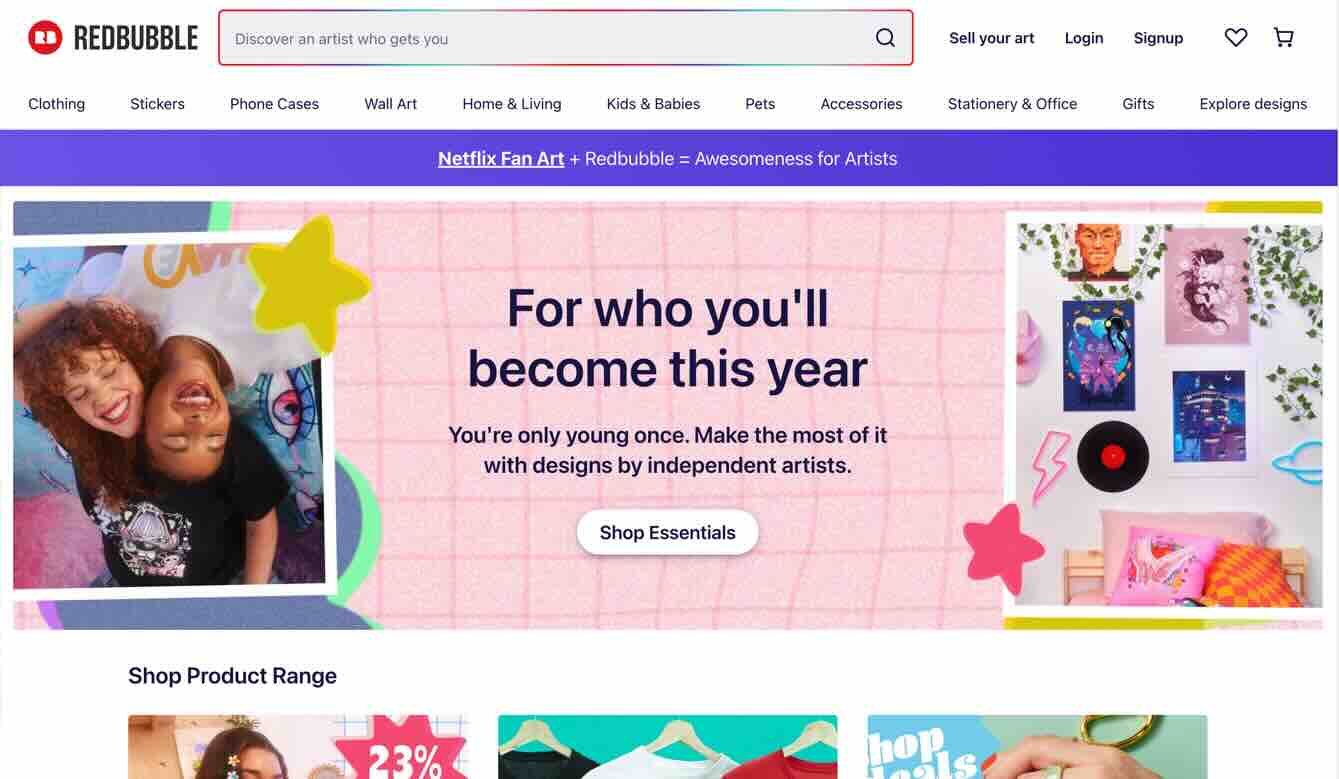
Redbubble was founded in Melbourne in 2006 and has grown to host over 700,000 artists worldwide with 17 million monthly visitors. It’s the largest independent artist marketplace in the world. The product range covers apparel, stickers, phone cases, home decor, notebooks, bags, art prints and more. Artists set their own markup above Redbubble’s base price — so you control your margin, at least in theory.
Society6 launched in 2009 with a slightly different philosophy — more curated, more focused on premium home decor and wall art, positioning itself as the more design-forward of the two. They’ve paid out over $100 million to artists since launch. The product range extends into furniture, rugs and more unusual lifestyle items. The commission structure is different — a fixed 10% on most products, with artists setting their own price only on art prints.
Those structural differences — Redbubble’s flexible markup versus Society6’s fixed commission — shape everything else about how the two platforms work and which one is right for your situation.
The Money Question — Royalties and Earnings Compared
This is the part most comparison articles get wrong by showing you the headline numbers without explaining what they mean in practice. Let me be specific.
On Redbubble: You set a markup percentage above the base price. The default is 20% — so on a product with a £15 base price you’d earn £3. You can increase this, but higher markups mean higher retail prices which can hurt conversions. There are also tiered platform fees depending on your seller status — standard sellers pay higher fees than premium sellers who’ve reached certain sales thresholds. The full cost structure is more complex than it first appears.
On Society6: You earn 10% commission on most products. On art prints — the one category where you control pricing — you can set your own markup and potentially earn significantly more. A £50 art print where you’ve set a £20 markup earns you £20, not £5. That’s a meaningful difference.
For a typical art print sale, Society6 can actually pay more per sale than Redbubble if you price correctly. For stickers, phone cases and apparel, Redbubble’s flexible markup gives you more control and potentially better margins.
The important caveat on Society6 is their promotional model. They regularly run 30-40% off sales — and those discounts come out of your markup, not their base price. Set your markup too low and a Society6 sale period leaves you earning almost nothing. The strategy is to set your base markup higher specifically to account for this.
Traffic — Where Are the Buyers?
This matters more than most artists realise when choosing a platform. All the perfect pricing in the world doesn’t help if nobody sees your work.
Redbubble has 17 million monthly visitors and is significantly larger in terms of raw traffic. For a new artist with no existing audience, Redbubble’s marketplace is where you’re most likely to make your first sale from organic platform traffic.
Society6 has a smaller but arguably more design-conscious audience — people who are specifically looking for art and design products rather than generic merchandise. If your work is strong on home decor appeal — patterns, illustration, typography — Society6’s audience is arguably better targeted.
The honest truth about both platforms in 2026 is that discoverability is harder than it was. Both marketplaces are saturated with uploads — and in Redbubble’s case specifically, the flood of AI-generated designs in the last two years has made it harder for original artists to stand out. You’re not just competing with other human artists anymore.
Which is why the most commercially successful artists on both platforms treat them as one channel among several rather than their entire strategy. They have their own Shopify store, their own email list, their own social media presence — and Redbubble and Society6 are additional passive income streams rather than the main event.
Product Range — What Can You Sell?
Both platforms cover the essentials — art prints, t-shirts, hoodies, phone cases, tote bags, mugs, notebooks. Beyond the basics they diverge.
Redbubble is stronger on apparel and accessories — if your work has a strong graphic, illustrative or subculture appeal, Redbubble’s clothing and sticker categories perform well. Their sticker category in particular is a reliable earner for many artists — low price point, high volume, good margins.
Society6 goes further into premium home decor — throw pillows, tapestries, rugs, shower curtains, furniture, yoga mats. If your work has a lifestyle and interior design application this breadth is genuinely useful. Society6’s wall art presentation is also notably higher quality than Redbubble’s — framed prints, canvas prints, metal prints — which suits artists whose work is intended for walls rather than t-shirts.
The UK-Specific Considerations
Both platforms operate globally but there are some practical differences for UK-based artists worth knowing.
Redbubble supports multiple currencies and multilingual storefronts — UK buyers can see prices in sterling which removes a meaningful friction point. Society6 operates primarily in US dollars which can create confusion and slight hesitancy for UK buyers seeing dollar prices.
Fulfilment for UK orders on both platforms typically involves international shipping from their fulfilment centres, which means delivery times and costs are higher than a UK-based alternative like Printful or Printify — both of which have EU fulfilment centres. Worth communicating clearly to buyers if you’re promoting your shop in the UK.
Tax and payment — both platforms pay out in USD via PayPal or direct bank transfer. Factor in currency conversion costs when calculating your actual earnings in sterling.
Analytics and Tools
Redbubble has a proper analytics dashboard — you can see where your traffic comes from, which designs are performing, what’s converting. For anyone who wants to understand what’s working and optimise accordingly, this is genuinely useful. Lucy frequently points out that I’m more interested in the analytics than the music when it comes to our band’s streaming numbers — fair point — and the same instinct serves artists well on print on demand platforms.
Society6 has minimal analytics. You can see your sales but not much about where buyers came from or which listings are getting views. For data-driven artists this is a real limitation.
Head to Head Comparison
| Redbubble | Society6 | |
|---|---|---|
| Founded | 2006 | 2009 |
| Monthly visitors | 17 million+ | Smaller, more curated |
| Commission model | Artist-set markup | 10% fixed (prints: artist-set) |
| Pricing control | ✓ All products | ⚠ Art prints only |
| Analytics | ✓ Good dashboard | ✗ Minimal |
| Home decor range | ⚠ Decent | ✓ Extensive — furniture, rugs |
| Apparel range | ✓ Strong | ⚠ Thinner |
| UK currency support | ✓ Yes | ✗ USD only |
| Sale promotions impact | ⚠ Moderate | ⚠ Significant — plan for it |
| Best for | Broad reach, apparel, stickers | Premium wall art, home decor |
Who Should Choose Redbubble
Redbubble is the right starting point if you’re new to print on demand and want maximum exposure with minimum setup complexity. The traffic is there, the product range is broad, the analytics give you something to work with, and the pricing control means you can experiment with margins without being locked into a fixed commission.
It’s particularly well suited to illustration-heavy work with subculture or niche appeal — fandoms, hobbies, humour, specific interests. Stickers and phone cases tend to perform particularly well in these categories.
The caveat: go in with realistic expectations. Artists with fewer than 50 designs typically earn under £50 a month. The artists making meaningful income have 200-500+ designs live and treat their shop’s SEO — titles, tags, descriptions — as seriously as the artwork itself.
Also worth reading: Printful vs Printify for UK Artists

Who Should Choose Society6
Society6 makes more sense if your work has strong home decor and interior design application — patterns, botanical illustration, abstract art, typography, landscapes. The platform’s audience skews toward people decorating their homes rather than buying graphic tees, and the product range reflects that.
For art prints specifically, Society6’s pricing model can outperform Redbubble if you set your markup correctly. Just account for their aggressive promotional calendar when setting your baseline price — give yourself enough room that a 30% off promotion still leaves you with a worthwhile margin.
Also worth reading: Etsy vs Shopify for UK Artists
The Honest Recommendation — Use Both
The artists making the most from print on demand in 2026 aren’t choosing between Redbubble and Society6. They’re running both simultaneously, treating each as a separate passive income stream targeting slightly different buyers, and building their own platform — a Shopify store, an email list, a social following — as the thing that actually drives traffic to both.
The platforms are free to join. Upload your best 20 designs to each, optimise your titles and tags properly, and leave them running. They won’t replace a sustainable income overnight but they’re genuinely passive — the comparison with music royalties isn’t entirely unfair. You do the work once and it earns while you’re doing other things. Even if that other thing is playing keyboards in a covers band on a Friday night.
If you’re thinking seriously about building a proper online art business beyond just the marketplaces, we’ve covered the full picture in our comprehensive guide to how to sell your art online. And if you haven’t yet compared Printful vs Printify for running your own print on demand operation through your own store — that’s worth reading alongside this.
Selling on Redbubble or Society6? Let us know how it’s going in our Facebook community of 15,000 UK artists — print on demand experiences and honest income reports are some of the most useful things our members share.