
Daler-Rowney Georgian oil paint is one of those products I’ve had a long and slightly complicated relationship with. Not because there’s anything complicated about the paint itself — there really isn’t — but because I’ve watched it from the inside of the industry for long enough to have a genuinely informed view of where it sits, who it’s for, and what the art world occasionally gets wrong about it. This is my honest take.
I spent nearly a decade as Digital Marketing Manager at ARTdiscount, one of the UK’s largest online art retailers, and I now run Discount Art Supplies — a price comparison platform used by tens of thousands of UK artists. I’ve watched Georgian sell consistently for years, I’ve seen the debates about it in online art communities, and I have a specific memory involving approximately 20,000 tubes of it that I’ll get to shortly. Here’s what I actually think.
Who Makes Georgian Oil Paint and Where Does It Come From?
Daler-Rowney is about as British as art materials manufacturing gets. The Rowney side of the business traces its origins all the way back to 1783 — when Richard and Thomas Rowney opened premises in central London selling perfumes and wig powder, of all things. The wig trade collapsed when it went out of fashion and the brothers, sensibly, pivoted to making colours for artists. It turned out to be a considerably better long-term bet. Turner and Constable were among their early admirers, which is not a bad endorsement to have on your first century of trading.
The Daler side came later — Terry Daler founded the Daler Board Company in 1946 after returning from a German prisoner of war camp, starting out in sign writing before moving into art materials. The two companies merged in 1983, creating the Daler-Rowney name that’s been on shelves ever since. Today the company is headquartered in Bracknell, Berkshire, where it manufactures over 30 million tubes and pots of colour every year — making it one of the last remaining artist colour manufacturers producing at any real scale in the UK. That’s worth noting in an industry where British manufacturing heritage is frequently claimed and rarely delivered.
Georgian oil paint has been part of the Daler-Rowney range for decades. It’s their mid-range oil colour — sitting above the entry-level Simply range and below the professional-grade Artists’ Oil Colour. The current range covers 58 colours, all triple-milled and all carrying lightfastness ratings of 3 to 4 stars. They’re made in Bracknell. Properly British paint.
The ARTdiscount Story — 20,000 Tubes and a Lesson in Buying Smart

I have a specific memory that puts Georgian oil paint in sharp context for me. Around 2014, ARTdiscount bought a very large stock of discontinued Georgian colours — I’m talking around 20,000 tubes. The colours had been pulled from the range, which meant they were available at a price that made the buying decision fairly straightforward from a commercial perspective. What I remember clearly is that it took us the best part of two years to sell the lot — and we did sell them all. Every single tube.
What that tells you is something important about Georgian’s customer base. These weren’t impulse buys. People were specifically coming back for colours they’d used before, or picking up discontinued shades they’d been meaning to try. That kind of deliberate, repeat purchasing behaviour is the most honest endorsement a product can earn. Nobody returns to a paint they don’t rate. The fact that 20,000 tubes of discontinued Georgian colours found homes over two years — without a massive marketing push, without discounting to the point of giving them away — says something genuinely useful about the loyalty the range commands.
I think about that experience whenever I see Georgian dismissed in online art forums as a beginner’s paint not worth serious attention. The artists buying those discontinued colours weren’t beginners.
What Georgian Oil Paint Actually Does Well
Let’s talk about the paint itself. Georgian is triple-milled — which means the pigment has been ground repeatedly to achieve a fine, consistent particle size that produces smooth, even application. That matters in practice. The consistency is genuinely buttery, which makes it pleasurable to work with straight from the tube. It moves well on canvas, covers well, and mixes predictably — colours behave consistently from wet to dry, which sounds like a basic requirement but is something cheaper student oils genuinely struggle with.
The lightfastness ratings of 3 to 4 stars across the range are solid. These aren’t fugitive colours that will fade noticeably in a well-lit room within five years. For most artists working in oil, Georgian’s lightfastness is entirely adequate. The range includes genuine Cobalt and Cadmium pigments — hues, not imitations — which at this price point is genuinely worth noting. A lot of student-grade ranges substitute cheaper pigments for the genuine cadmiums and cobalts and don’t always make that substitution obvious. Georgian is transparent about what’s in the tube.
Drying time is reliable — surface dry within 4 to 5 days depending on the colour, which is standard for a traditional oil and means you can plan your working sessions predictably. The low-odour formulation makes Georgian more practicle for studio use in ventilated indoor spaces, though you’ll still want proper ventilation when using solvents and mediums alongside them. If you want to explore Georgian mediums and solvents, check our paints and mediums deals page for the best current UK prices.
The range of 58 colours covers the working palette comprehensively. You’re not going to find yourself missing a key colour family. The selection is well-judged — strong across primary mixing colours, earths, and the specific blues and greens that landscape painters reach for most often.
Where Georgian Sits in the Market — and Who It’s Actually For
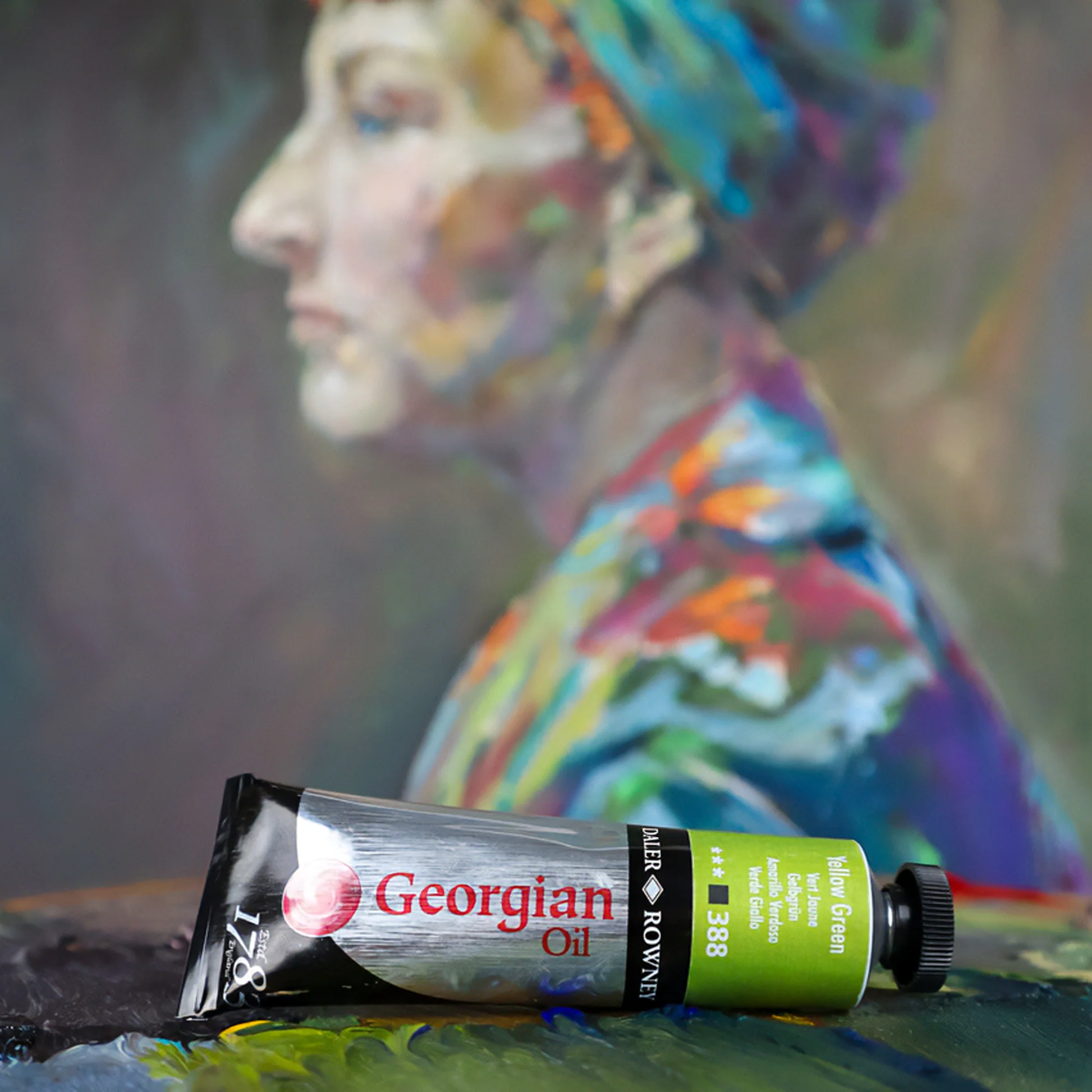
The honest answer to “who is Georgian for” is a broader group than its positioning as a student paint suggests. Yes, it’s the right choice for someone learning oil painting who wants better than entry-level quality without committing to professional prices. The starter sets — six 22ml tubes carefully selected for a versatile beginner palette — are genuinely well put together and represent an intelligent first purchase for anyone new to oil.
But Georgian also serves a second group that doesn’t get talked about enough: established oil painters who use it alongside professional-grade colours for specific purposes. Large areas of canvas that would consume expensive paints at an alarming rate. Underpainting and blocking in, where the quality of the final professional-grade colour goes on top anyway. Studio mixing and colour testing where you don’t want to use your best pigments. Outdoor painting where taking expensive materials carries obvious risks. Georgian is the right answer for all of those scenarios, and plenty of serious painters know it.
Where Georgian genuinely doesn’t compete is at the very top of the professional market — against Winsor & Newton Artists’ Oil, Old Holland, Michael Harding, or Williamsburg. The pigment load is lower, the variety of single-pigment colours is smaller, and the depth of colour in the highest chroma shades isn’t quite there. For artists whose work goes to collectors and galleries, whose paintings will be judged against archival professional standards, those differences matter. For everyone else — which is the majority of oil painters — they probably don’t.
Georgian Water Mixable Oil Paint — Worth Considering
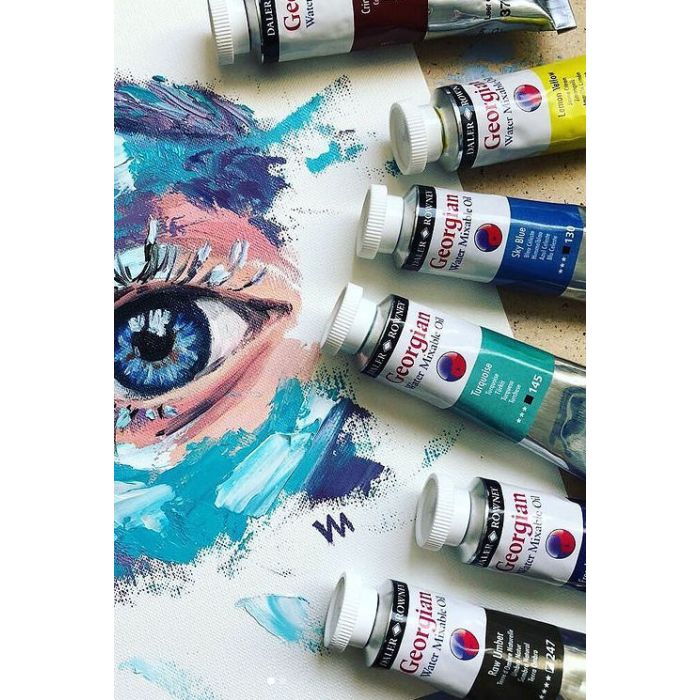
One product in the Georgian range that deserves specific mention is the Water Mixable Oil Paint. These are genuine oil colours modified to be thinnable and cleanable with water rather than turpentine or white spirit — making them a genuinely useful option for artists who work in shared spaces, with children around, or who simply want to reduce their exposure to solvents.
The water mixable version carries the same lightfastness ratings as the traditional Georgian range and performs similarly on canvas. The drying time is slightly longer — 5 to 7 days to surface dry — and the handling is marginally different to traditional oils, particularly in how they blend. Most artists who switch from traditional to water mixable need a short adjustment period. But for the audience they’re designed for — beginners, artists working in classrooms or shared studios, anyone sensitive to solvent fumes — they remove a significant practical barrier to oil painting, and I think that matters.
I’ve always believed the art world is better when more people can access it. Water mixable oils don’t get enough credit for what they do in practical terms — making oil painting genuinely accessible to people who couldn’t otherwise manage the ventilation requirements. Georgian’s version is one of the better ones available at the price point. We stock the Daler-Rowney Georgian Water Mixable Oil Set — 10 colours, 20ml and it’s well worth checking the current price before you buy elsewhere.
The Sets and Formats — What to Buy
Georgian is available in three tube sizes — 22ml, 38ml, and 225ml. For most painters the 38ml is the right everyday size, offering meaningful volume without committing to large quantities of colours you might use less frequently. The 225ml large tubes are genuinely useful for colours you’ll go through at pace — Titanium White most obviously, which most oil painters consume faster than any other colour. Buying Titanium White in the large tube is almost always better economics than buying multiple standard tubes.
The sets are well-curated. The Starter Set with six 22ml tubes is a sensible introduction. The Studio Set — ten 38ml tubes plus a Georgian brush — is the better choice for anyone moving past the very beginning stages and wanting a proper working palette. The Selection Set of ten 38ml tubes without the brush is the right option if you already have brushes and just want to expand your colour range. Compare prices on all Georgian sets at Discount Art Supplies before buying — we track prices across all major UK retailers in real time.
The Kandinsky-inspired set, created in partnership with Tate Britain to mark their Turner & Constable exhibition, is worth a mention for the art history angle alone — Georgian oil paint being paired with two of the artists whose predecessors were inspired by the original Rowney colours two centuries ago has a pleasing circularity to it.
The Verdict
Georgian oil paint is a genuinely good mid-range oil that has earned its place in the market over decades of consistent performance. It’s not trying to be Winsor & Newton Artists’ Oil and it doesn’t need to be. Triple-milled, reliably lightfast, well-priced, made in the UK by a manufacturer with 240 years of colour-making experience — that’s a strong proposition at the price point it occupies.
The 20,000 tubes I watched sell at ARTdiscount over two years tell me more about Georgian’s real-world value than any technical specification. Artists who know what they’re doing kept coming back for it. That’s the most honest review a product can get.
If you’re learning oil painting — Georgian is the right starting point. If you’re an established painter who needs a reliable, affordable option for underpainting, large areas, or studio work — Georgian belongs in your cupboard. And if you’re looking for the best current UK price on Georgian oil paints, Discount Art Supplies compares prices across all major UK retailers in real time so you always know you’re getting the best deal available. Don’t forget to check out the Georgian Water Mixable Oil Set if solvents are a concern — it’s one of the better water mixable options we stock.
More Reviews and Guides
- Discover Bristol’s 7 Best Art Supply Shops
- Discover Birmingham’s 7 Best Art Supply Shops
- The 7 Best Art Shops in Manchester
- The 10 Best Art Shops in Liverpool
- The 6 Best Art Supply Shops in Sheffield
- The 6 Best Art Supply Shops in Nottingham
- The 5 Best Art Supply Shops in Cambridge
- The Top 7 Art Shops in Edinburgh
- The 6 Best Art Supplies Shops in Glasgow
- Brighton’s 8 Best Art Shops